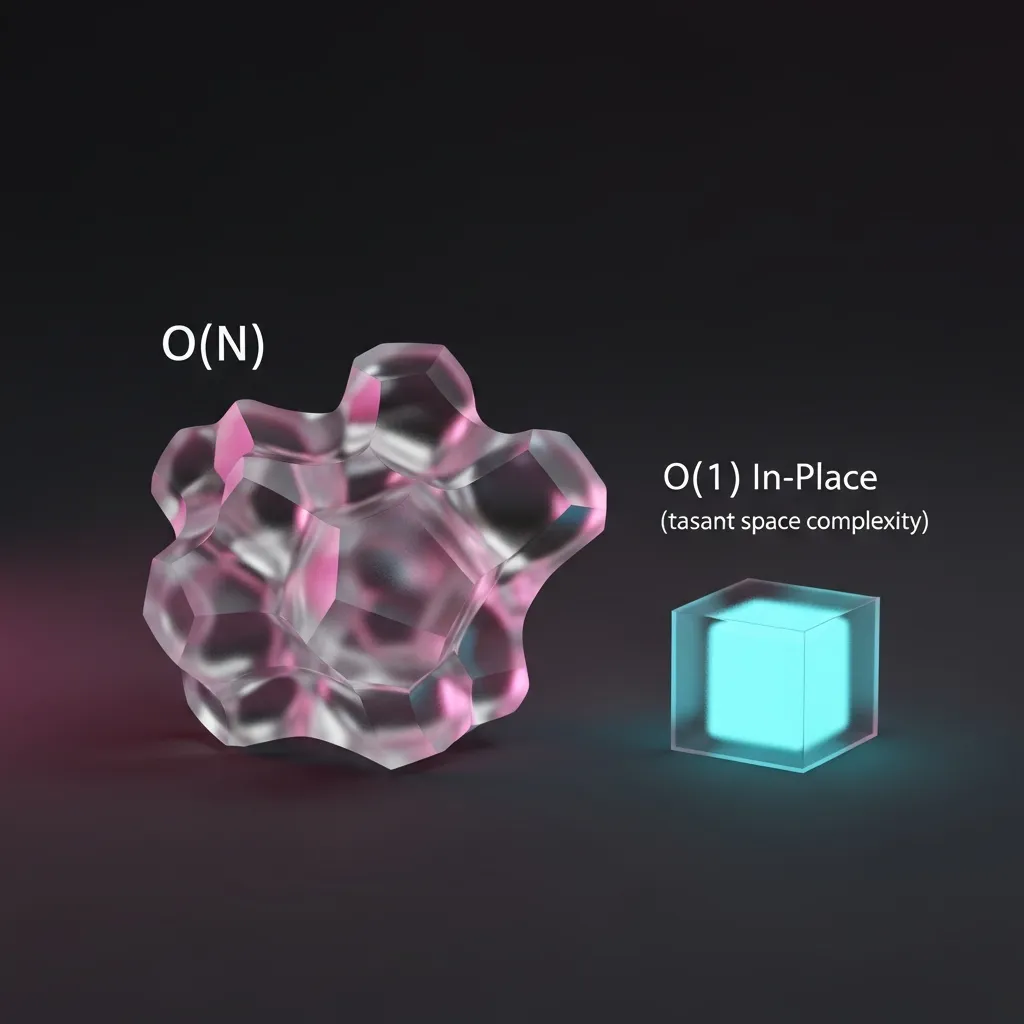
The Invisible Cost of Code: Why Interviewers Obsess Over Memory
When preparing for technical interviews, candidates often focus fiercely on speed—Time Complexity (Big O notation like O(N) or O(log N)). But there’s a quieter, equally critical metric that separates good engineers from great ones: Space Complexity.
Space complexity measures the amount of memory or storage an algorithm needs to run. In the real world, unnecessary memory usage costs money, slows down systems, and limits scalability. As job seekers, understanding this concept is crucial—it demonstrates that you’re not just writing functional code, but responsible code, ready to protect critical system resources.
What Exactly Is Space Complexity?
Space complexity is typically broken down into two components:
- Input Space: The space required to store the input data itself (e.g., an array of 1000 items).
- Auxiliary Space: The extra, temporary space an algorithm uses during execution (e.g., temporary variables, stacks, or creating new data structures).
When interviewers discuss Space Complexity, they are usually referring to the Auxiliary Space. This is the memory footprint your algorithm adds beyond the input. Mastering auxiliary space is key to optimization.
The Efficiency Hierarchy: O(N) vs. O(1)
Most algorithms fall into one of two major categories concerning auxiliary space:
1. Linear Space Complexity (O(N))
If your algorithm creates a temporary data structure whose size scales proportionally with the size of the input (N), you have O(N) space complexity.
Example: If you need to process a list, and your approach involves creating a brand-new list of the same size to store the results or temporary values, you are using O(N) auxiliary space. This is acceptable for many tasks, but it effectively doubles the required memory resources.
2. Constant Space Complexity (O(1))
This is the gold standard in memory efficiency. O(1) means the amount of temporary memory used is constant, regardless of the size of the input (N). Whether you process 10 items or 10 million, the memory overhead remains the same. This efficiency is the core feature of In-Place Algorithms.
The Power of "In-Place" Algorithms (O(1) Memory)
An algorithm is considered In-Place if it transforms the input data structure without allocating significant extra storage. It works directly within the memory already allocated for the input, often using only a few extra variables (pointers, counters, or temporary swaps).
Why In-Place Algorithms Are Valued
- Resource Protection: O(1) algorithms are maximally memory efficient. For large datasets common in big tech, this can prevent crucial system errors like "Out of Memory" exceptions and save significant computing costs.
- Scalability: In-place solutions handle massive inputs gracefully because their memory usage doesn't grow with the data size. They are the most robust solutions when memory constraints are tight.
- Interview Signal: By designing an O(1) solution, you signal to the interviewer that you understand resource limitations and prioritize robust, professional code. You show you can optimize beyond the basic functional approach, often elevating you above competing candidates.
Common In-Place Examples: Bubble Sort, Insertion Sort, selection algorithms using two pointers, and efficient implementations of Quicksort.
Translating Complexity to Career Success
Just as space complexity helps protect systems from unnecessary overhead, RolePilot exists to protect candidates from unnecessary career roadblocks.
Mastering technical concepts like space complexity ensures you can answer tough interview questions with confidence. It shows you think critically about implementation details, not just surface-level functionality. We believe in empowering you to show up as the most prepared and resourceful candidate.
This awareness of optimization doesn’t just apply to coding; it applies to your job search process, too. Are you efficiently using your resources (time, energy, and resume space)? Ensure your application materials are optimized for both human recruiters and automated systems.
Frequently Asked Questions About Space Complexity
Is O(1) space always faster than O(N) space?
Not necessarily. Space Complexity deals with memory usage, and Time Complexity deals with execution speed. Sometimes, using extra O(N) space (like a hash map or cache) allows an algorithm to achieve a much faster time complexity (e.g., reducing time from O(N^2) to O(N)). Optimization often involves a time-space trade-off. Great engineers know how to balance them based on the specific system requirements.
What is the space complexity of recursion?
Recursion often has O(N) space complexity due to the function call stack. Each recursive call adds a new stack frame (holding local variables and return addresses), and if the recursion depth is proportional to N (as often happens in linear traversals), the space complexity is O(N). Iterative solutions are often preferred for critical systems to guarantee O(1) auxiliary space, where possible.
Ready to Protect Your Career Assets?
Don't let inefficient code—or inefficient job search strategies—cost you the opportunity. Understand how your code impacts memory and how your resume impacts the hiring process.
If you’re unsure whether your current resume is efficiently structured to pass the initial screening robots, make sure you run it through our advanced checking tool.