
Why Your Achievements Need Digital Clarity
In today’s job market, your resume doesn't first land in the hands of a recruiter—it lands in the digital clutches of an Applicant Tracking System (ATS). These sophisticated parsers are designed to scan for keywords, relevance, and, critically, measurable impact.
Vague statements like "Responsible for managing social media" simply won't cut it. They are difficult to parse, impossible to quantify, and fail to distinguish you from the thousands of other applicants. This is where Google’s famed XYZ Formula, often attributed to former Google SVP of People Operations, Laszlo Bock, becomes your most powerful tool.
The XYZ formula is a structure designed to ensure every bullet point clearly communicates impact, measurability, and method. It’s the key to making your accomplishments readable by both AI and human eyes.
Deconstructing the XYZ Formula
The formula provides a standardized, quantifiable framework:
Accomplished [X] as measured by [Y] by doing [Z]
Let's break down the components and see how they translate into ATS-friendly data points.
X: The Accomplishment (The What)
This is the result or the outcome. It focuses on what you achieved, not just what you were responsible for. It requires a strong action verb (e.g., Increased, Reduced, Streamlined, Launched, Optimized).
- Bad Example (Focus on Duty): Managed customer service inquiries.
- Good Example (Focus on X): Increased customer satisfaction ratings.
Y: The Quantification (The Measurement)
This is the most critical component for ATS parsers. Numbers, percentages, frequency, scale, and timeframes provide concrete data that the AI can easily extract and rank. Without Y, X is just an assertion.
- Example Y Metrics: 20%, $50,000, 500 users, 18 months, three states.
Z: The Action/Method (The How)
This explains the specific steps or strategies you took to achieve X. This demonstrates your skills, problem-solving ability, and process.
- Example Z Methods: by implementing a new ticketing system; by redesigning the mobile interface; by training a remote team of ten specialists.
Transforming Vague Duties into ATS Gold
The power of the XYZ formula lies in its ability to transform abstract duties into demonstrable, quantifiable value.
| Vague Statement | XYZ Transformation |
|---|---|
| Handled social media. | Accomplished a 45% increase in audience engagement (X) as measured by follower growth and shares (Y) by doing a comprehensive content audit and launching two weekly video series (Z). |
| Improved sales. | Accomplished $150,000 in new recurring revenue (X) as measured by Q4 performance reports (Y) by doing targeted outreach to five key enterprise accounts (Z). |
| Reduced costs. | Accomplished a 12% reduction in operational spending (X) as measured by quarterly budget reports (Y) by doing supplier negotiations and consolidating software subscriptions (Z). |
The ATS Advantage of Quantifiable Data
ATS systems love quantification because it provides objective metrics for comparison. When the parser scans your document, it isn't just looking for keywords; it is assigning value.
If a job description asks for someone who "Increased client retention," an ATS is programmed to look for numbers (Y).
- "Increased client retention" (Vague): Score 3/10.
- "Increased client retention by 25%" (Quantified): Score 8/10.
Quantified achievements immediately boost your relevance score, moving you out of the 'discard' pile and into the recruiter's inbox. If you are worried about whether your current resume is optimized, use an ATS checker tool before applying. (See: /ats-check.html)
3 Steps to Implementing the Formula
Implementing the XYZ formula isn't just about rewriting—it’s about reframing your professional narrative.
Step 1: Inventory Your Impact, Not Your Duties
Forget your job description. Start by listing 5-10 major positive impacts you've had in each role. Think about problems you solved, resources you saved, or processes you improved.
Step 2: Hunt Down the Numbers (The Y Factor)
This is often the hardest part. If you don't have exact figures, estimate reasonably. Did you manage a team of 8? Did your project save 4 hours a week? Did you deal with 50 clients daily? Use these figures. If you can’t use a dollar or percentage sign, use scale and scope.
Step 3: Integrate and Polish
Draft your statements using the X-Y-Z flow. Prioritize the most impressive achievements first. While the rigid "Accomplished X as measured by Y by doing Z" is a great drafting template, you can vary the sentence structure in the final resume for better flow, as long as the components (X, Y, Z) are clearly present.
Final Check: Are You Truly ATS-Ready?
When reviewing your resume, ask yourself three questions for every bullet point:
- Did I use a strong action verb (X)?
- Is there a clear, measurable metric (Y)?
- Did I explain the method or skill used (Z)?
By rigorously applying the XYZ formula, you shift your resume from a list of responsibilities to a compelling document proving the tangible value you bring. This strategic quantification is your best defense against the ATS and your strongest case for landing the interview.
\n\n \n\n
\n\n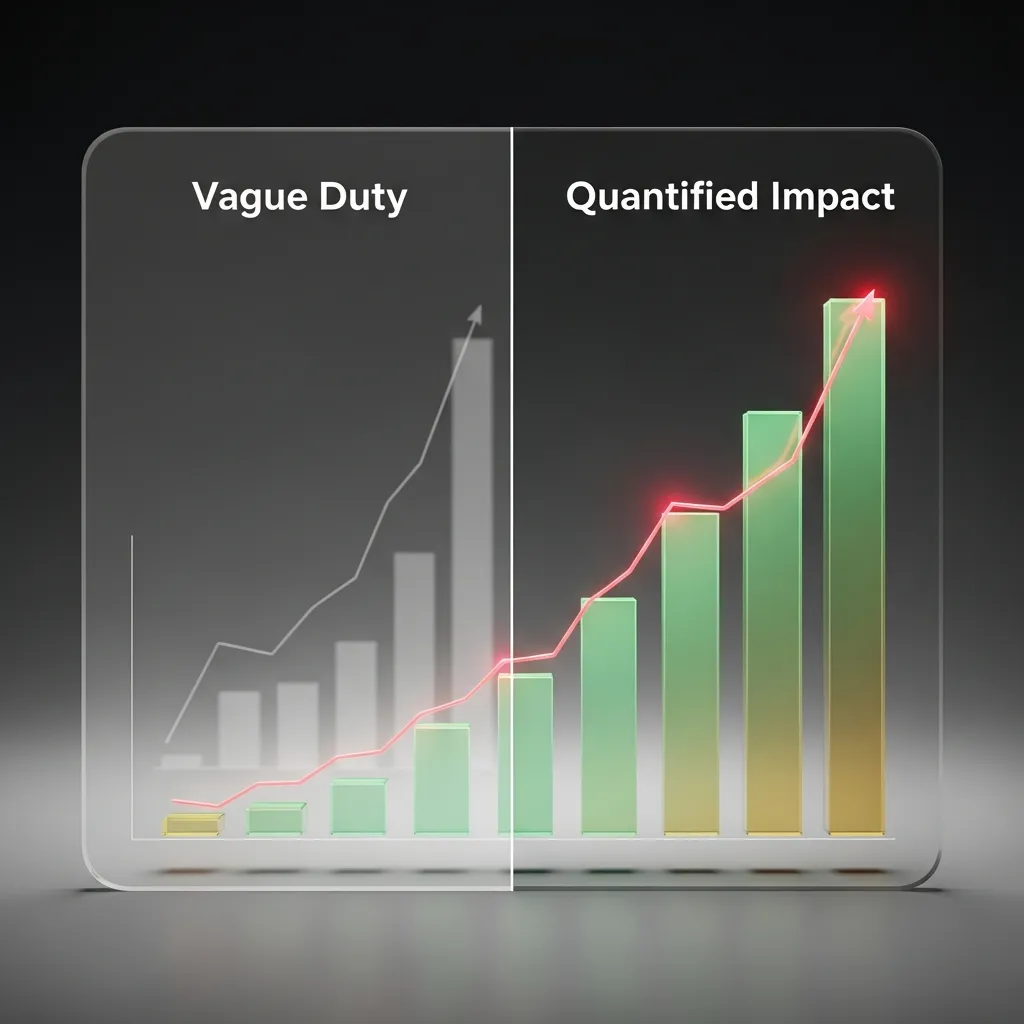 \n\n\n\n
 \n
\n