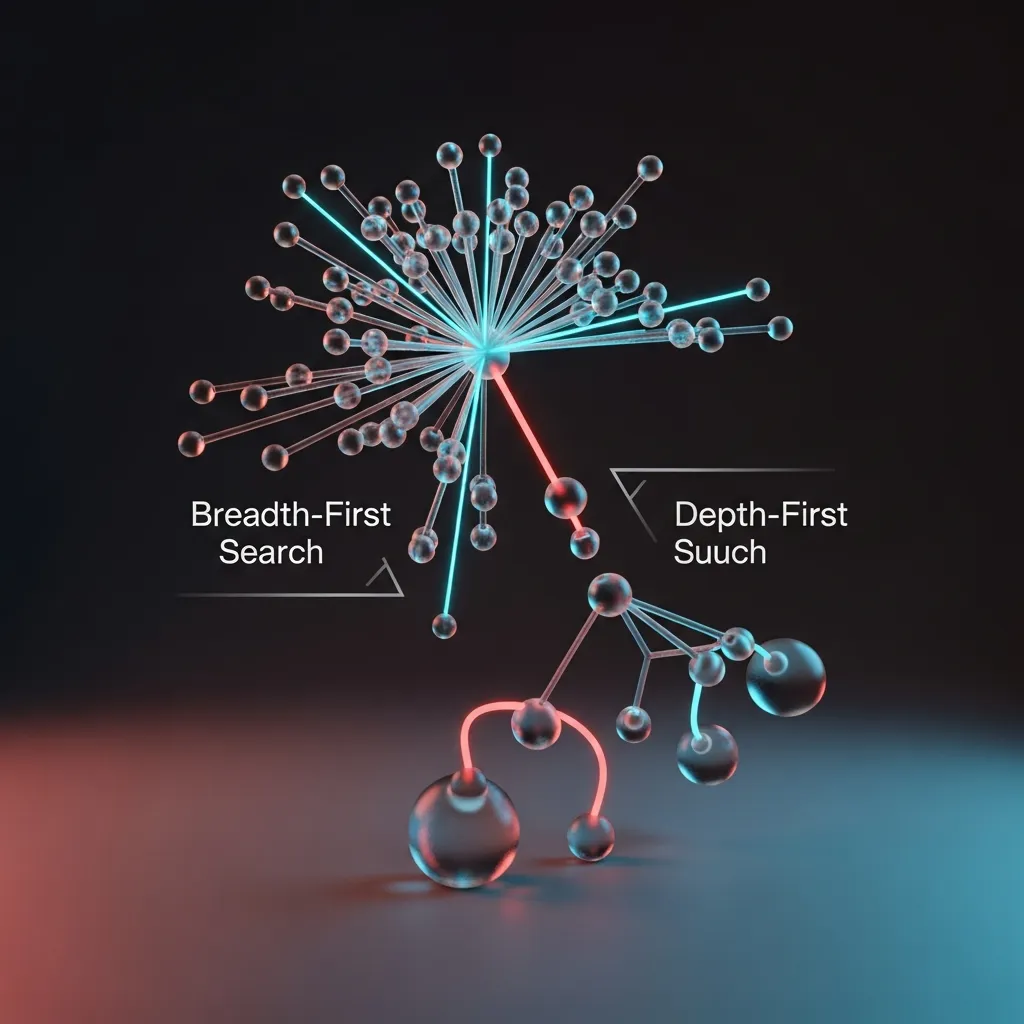
Why BFS and DFS Knowledge is Your Interview Shield
If you're gearing up for a technical interview, especially for a Software Engineer role, the acronyms BFS (Breadth-First Search) and DFS (Depth-First Search) feel like high-stakes gatekeepers. It’s easy to get bogged down in the specifics of queue vs. stack, recursion vs. iteration, and lose sight of the bigger picture: why do companies care about these concepts?
They care because graphs—structures made of nodes (vertices) and connections (edges)—are everywhere in computing. Your ability to navigate and process these structures efficiently, using either BFS or DFS, demonstrates fundamental problem-solving maturity. It shows you understand the paradigms that underpin networking, database indexing, and even how your application code is compiled.
Let's cut through the theory and explore where these algorithms truly live in production, giving you the context you need to ace that technical screen.
The Real-World Impact of Breadth-First Search (BFS)
BFS is defined by its method of exploring a graph layer by layer—checking all neighbors before moving deeper. This makes it ideal for finding the shortest path.
1. Networking and Routing
When you click a link or send an email, data packages need to find the fastest, most efficient route across the internet. While Dijkstra's algorithm and A* are often used for complex weighted routing, their foundational logic often relies on BFS principles. Why? Because BFS naturally minimizes the number of hops (edges) required to reach a destination, making it excellent for finding the shortest unweighted path.
2. Social Media Connection Recommendations
Think about friend suggestions on LinkedIn or Facebook. These platforms use variations of BFS to find users who are closely related to you (friends of friends). A BFS approach guarantees that you find the closest connections first, essential for calculating your "degree of separation" from others.
3. Web Crawlers and Search Engine Indexing
Search engines like Google use crawlers to discover and index new web pages. A crawler employing a modified BFS is beneficial because it systematically explores links on a page, then links on those pages, and so on. This ensures a broad, comprehensive indexing effort that prioritizes high-level, critical pages before descending into less important sub-pages.
The Production Power of Depth-First Search (DFS)
DFS prefers deep exploration. It dives as far as possible down one path before backtracking. This makes it perfect for scenarios requiring complete structural exploration.
1. Abstract Syntax Trees (AST) in Compilers
When a programming language compiler reads your code, it first converts it into an Abstract Syntax Tree (AST). Compilers use DFS to traverse this tree. By exploring one branch of the syntax (e.g., a function definition) completely before moving to the next, DFS ensures the compiler correctly interprets the hierarchy and dependencies of your code. This is fundamental to all modern programming.
2. File System Traversal and Backup
When you run a recursive search or a backup program that needs to scan every subdirectory and file on your computer, that program is likely using DFS. DFS’s ability to fully explore a path (a specific directory) before returning and exploring the next sibling directory makes it a natural fit for hierarchical file systems.
3. Topological Sorting
In build systems (like Make or Gradle), you often have dependencies (e.g., file A must be compiled before file B). Topological sorting—an algorithm that requires DFS—determines the correct order in which tasks must be executed to satisfy all dependencies. Without DFS, complex projects couldn't reliably build.
Prepare Beyond the Code: Applying Context
When you face an algorithmic question in an interview, don't just solve the problem—explain why you chose the approach. If it's a shortest path problem, confidently state, “I’m choosing a BFS approach because it guarantees the optimal solution in an unweighted graph.”
Your ability to connect theoretical algorithms to real-world software engineering contexts signals maturity and immediate value to a hiring manager. At RolePilot, we advocate for this contextual understanding because we know how stressful the technical gauntlet can be. We want you protected and prepared.
Ready to ensure your basic application documents pass the first hurdle?
Frequently Asked Questions (FAQ)
Q: Which algorithm is generally faster, BFS or DFS?
Both BFS and DFS typically have the same time complexity ($O(V+E)$), where $V$ is the number of vertices and $E$ is the number of edges. The difference lies in their application: BFS is faster for finding the shortest path in unweighted graphs. DFS is often more memory efficient for exploring very deep graphs because it doesn't need to store all sibling nodes simultaneously (as BFS does).
Q: Do production systems use pure BFS/DFS?
Often, production systems use algorithms that are built upon the core logic of BFS or DFS. For example, routing uses Dijkstra’s or A*, which utilize priority queues but fundamentally employ a similar systematic search pattern as BFS.
Don't Let the Bots Block Your Path
Understanding graph algorithms gets you past the technical interview, but first, you need to get past the Applicant Tracking System (ATS).
RolePilot is your Candidate Protector, ensuring your resume and cover letter are optimized for human eyes and machine scanners. Before diving deeper into graph theory, make sure your job application basics are covered. Use our free, powerful ATS Reality Check tool to maximize your visibility and secure that interview slot where you can demonstrate your BFS/DFS expertise!